Wikileaks Under Attack

The WikiLeaks website crashed Tuesday in an apparent cyberattack after the accelerated publication of tens of thousands of once-secret State

Destroy Ur Friends PC Using Virus

In this post we'll take a look on how to create a deadly computer virus to destroy your enemy or victim's PC.

USB 3.0 Evolution xD

USB 3.0 > Usb 2.0 > Usb 1.0 xD

MEet Top ten techies Who changed World around Us

Top Ten Techies...

Steal Your Frnds Password using Flash Drive

Yes Ew Heard it Correct...CLick to know the trick :)

Showing posts with label future technology. Show all posts

Saturday, 9 February 2013

Samsung Galaxy Q With Full HD Flexible Display To Be Announced At MWC 2013


Samsung Galaxy Q
It seems that even though Samsung Galaxy S4 release date was not set or MWC 2013, there will be another Samsung terminal that will attract the public’s attention.
I am talking about Samsung Galaxy Q, a dual-display smartphone, which was previously teased by the South Korea-based phone maker. The guys atMobileGeeks have information that the model is real, and that Samsung will announce it at Mobile World Congress 2013 in Barcelona.
The idea behind the Samsung Galaxy Q concept is that the two displays can be “united” in a single 1,080p screen. It’s true there were other companies that failed with their attempts to make successful dual-screen terminals, and the best examples are Kyocer, with Echo smartphone, while Sony’s Tablet P is not as popular as the Japanese company hoped.
It seems that Samsung Galaxy Q will use the FPD Display OLED technology presented by the Asia company a couple of years ago. You can see a video footage of the Flexible OLED display Samsung demoed in 2008.The first rumors about Samsung Galaxy Q surfaced in October 2012, and the creators of the popular Galaxy S line-up have confirmed that the product will be announced early 2013.
In the meantime Samsung has improved the flexible OLED display technology and the company exposed the YOUM concepts at the big tech fairs of the last years. A Samsung Youm prototype was displayed at this year’s CES edition, and even launched afunny commercial.
Rumor has it that Samsung Galaxy Q will have two 5.3-inch displays which can be folded outwards to form a single display, in a similar way you’ve seen in the commercial above.
There are no details about the hardware platform that will underpin the Samsung Galaxy Q, but since we are dealing with a full HD display, we might be talking about company’s proprietary Exynos 4 Quad or Exynos 5 Dual chipsets.
Would you buy a Samsung terminal with a full HD flexible display?

Sunday, 11 September 2011

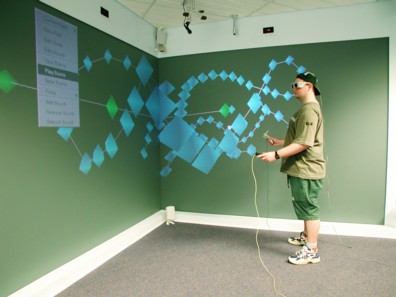
Virtual Reality Technology


Exponential growth in computer power is enabling the creation of exceedingly lifelike graphics and 3D environments. At the same time, faster broadband is opening up new frontiers in cyberspace, allowing the development of Web 3.0 - 


the next generation of Internet. Combined with developments in on-person hardware, this is leading to a rebirth of virtual reality. Having been something of a gimmick in the 1990s, it is now becoming a serious tool for business, leisure, education and training.

Much of the content in these environments is user-generated, with online communities for sharing and exchanging virtual objects, buildings, avatars, etc.
For the wealthy, some of the hardware options now available include pod-like structures which are fully enclosing and respond to a variety of gesture commands

Web 4.0 the future of Internet landscape


Further convergence of the online and physical world has led to the emergence of "Web 4.0" - the next generation of internet. Semantic analyzing programs, having evolved into forms of AI, now perform a huge range of automated tasks for business, government and consumers. Running on massively parallel networks, these applications hunt for textual and visual data - combining the most subtle capabilities of humans (such as pattern recognition) with ways in which machines are already vastly superior (such as speed and memory).


In addition to serving as highly advanced search engines, they are playing a major function in the real world - gathering information from the array of sensors, cameras and other tracking devices now present in the environment, on vehicles, and even on people themselves.
Although privacy and civil liberties issues are being raised, this new generation of IT promises to bring enormous benefits to society. Crimes are faster and easier to solve thanks to these intelligent virtual agents; transport and logistics are smoother and more efficient; resources can be managed and distributed more accurately.


In addition, practically every physical document in existence has now been digitally encoded, backed up and archived online. This includes full copies of all books, journals, manuscripts and other literature ever published – forming a complete repository of human knowledge going back thousands of years. These documents can be retrieved and analysed using real-time speech commands, translated from any of the world's 6,000 languages and accessed via 3D holographic imaging.


Web 4.0 is also democratising the Internet more than ever before. News agencies are finding themselves increasingly outmoded by bloggers and other social media when it comes to speed and accuracy of information.


The iPhone of 2020


Designer Josselin Zaïgouche, who created the Zero Phone we’ve shown you half an year ago has now sent us an incredible design, the Apple Black Hole concept, possibly the iPhone of the year 2020. “What’s going to happen in 10 years” asks the designer and the answer should look something like this
As you can see, the Apple Black Hole comprises 4 components: the charging base, the Prism, the Black Hole and the giftbox. Things get interesting when you try to use the handset… its central ball will levitate when you open your hand and all functions will be controlled in mid-air, with the aid of holographic technology. How cool is that?
The Black Hole concept phone can be connected to the charging base and used as a desktop device, still projecting the needed interface. Brilliant? Yes! Viable? Maybe…

Practical flying cars


Anti-gravity propulsion has been under development for almost a century now.* Initially seen in military applications, it eventually found its way to the consumer market. Here, it began showing up in various luxury items and devices, such as hoverboards and floating recliners.
Further refinement of this technology - together with advances in AI, microjets and collision avoidance systems - has led to the dawn of a new era in personal transportation. In the late 2070s, it is not uncommon to see what citizens of earlier decades might describe as "flying cars" moving through cities.


In fact, these are light-duty vehicles based on earlier military VTOL (Vertical Take-Off and Landing) craft, but with slimmed down functionality and costs. They come in a variety of models and sizes, but are typically around 4 metres wide, and limited to a maximum of one or two passengers. By the end of this decade, they are becoming cheap, safe and numerous enough to be regarded as a mainstream form of transport.


The craft have a number of advantages over established forms of mobility. Since they float above the ground, they can access terrain and environments that would easily defeat traditional automobiles. This makes them popular with adventurers and explorers. They are also substantially faster than normal cars, able to reach several hundred kilometres per hour if necessary. They are more versatile and manoeuvrable than aeroplanes and can utilise a much greater volume of airspace. Since the traffic they generate is decentralised and there is so much available airspace, this makes them safer than both cars and aeroplanes, too. Collisions are almost unheard of, in any case, due to the onboard software and AI.
In addition, they use considerably less fuel than earlier forms of transport and require less maintenance.


Some of the more expensive models are capable of reaching low Earth orbit for short periods. Others feature striking designs, often personalised by their owner - such as holographic decals and other accessories. These craft are being used by many businesses too (especially for rapid delivery of goods), as well as police and ambulance crews.
Further developments in anti-gravity will lead to bigger, more sophisticated versions - including recreational vehicles serving as truly mobile homes. Many previously inaccessible parts of Earth will become inhabited thanks to this, such as mountains and remote islands.

The Multi-touch surface computing


These coffee table-sized devices have been appearing in business venues for a couple of years already. They are now becoming cheap enough for the consumer market.
This computing platform responds to natural hand gestures and real world physical objects. It has a 360-degree user interface and a large reflective surface, with projectors underneath which project images onto its underside. Cameras in the machine's housing record reflections of infrared light from objects and fingertip movements.


The surface is capable of object recognition, object/finger orientation recognition and tracking, and is multi-touch and is multi-user. Users can interact with the machine by touching or dragging their fingertips and objects such as paintbrushes across the screen, or by placing and moving placed objects. The platform can respond to over 50 touches at a time.
The use of multi-touch technology is increasing exponentially during this time. For example, sales of touchscreen phones will rise from 200,000 in 2006 to over 21 million by 2012, while iPads and other tablet devices are seeing similar growth.


Share

Twitter Delicious Facebook Digg Stumbleupon Favorites